
Boating safety course
Preparation for the boating safety course covers steering rules, buoyage and safety. This training is for people wanting to drive motorboats at sea. The syllabus includes theory and practical assessment.
Free · No obligation
A Boating School in Pine Bluff for your boating safety course and boat handling skills.
A Boating School trains future skippers to drive motor cruisers and powerboats safely. This training establishment prepares candidates for the theoretical and practical assessments of the boating safety course. You can call a Boating School in Pine Bluff to learn navigation rules, buoyage and safety at sea. The instructors provide structured teaching to guide your learning on the water.
Training usually starts with studying maritime rules for the theory assessment. Practical learning then takes place at the helm of a registered training vessel. The pro validates your boat handling skills through continuous assessment recorded in your logbook. You can contact a training center in Pine Bluff to sort out your booking and plan your time on the water.
Preparation for the boating safety course covers steering rules, buoyage and safety. This training is for people wanting to drive motorboats at sea. The syllabus includes theory and practical assessment.

Classroom theory sessions help you learn maritime signals and navigation rules. An instructor explains situations encountered at sea and prepares students for the theory exam. This course encourages direct interaction.

Providing an online space allows you to review navigation rules remotely. This digital tool includes paperless courses and practice boating exams. It is used to practice theory before the assessment.

Learning on the water aims to master boat handling and passenger safety. The instructor teaches course keeping, man overboard recovery and radio operation. Skills are progressively signed off in the logbook.

Teaching marina maneuvers helps you leave and come alongside with precision. The instructor explains the use of mooring lines, fenders and the effect of the wind. These sessions improve the helm's confidence in tight spaces.

The training center assists the candidate with the necessary paperwork. The pro gathers the required documents and submits the application to the relevant body. This service makes registering the future boater easier.

This theory module is specifically for people preparing for the Offshore Navigation Course. The instructor explains how to anticipate water level changes to navigate without distance limits. This technical teaching helps plan complex passages.

Specific training on a sailing yacht covers docking techniques unique to these vessels. This optional nautical improvement does not aim for a mandatory certificate. It is for sailors wanting to maneuver their sailboat safely.
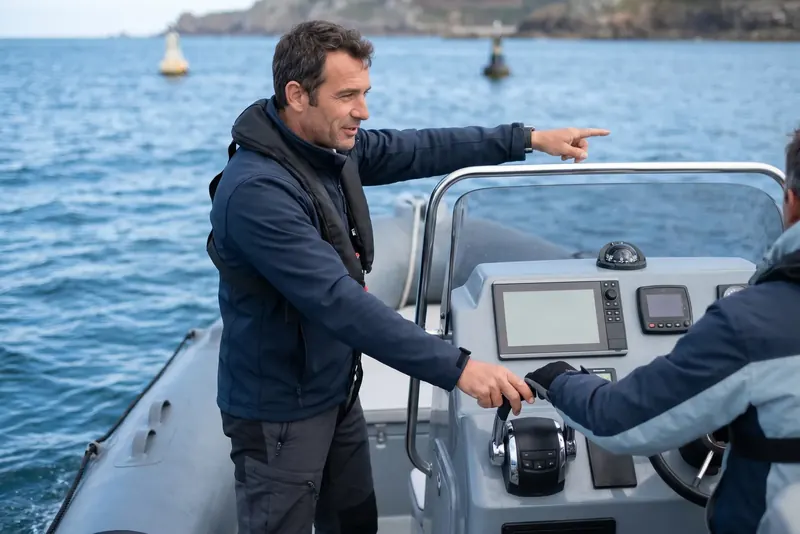
A Boating School provides structured courses.
The price mainly depends on the elements below. The exact price is the one the pro displays or writes on their estimate, drawn up for your need.
For each service and each town, Kelki explains the essentials: the services, when to call a pro and pointers to choose well. With « Call me back », you describe your need in a few clicks: your request goes to a professional of the trade in your area, and you then deal with them directly.
Neighborhoods and neighboring towns: each has its own page, ensuring your request is sent with the right location.
You just need to define your expectations regarding certificates or skills improvement. You can describe your need on Kelki to get local proposals. You can then compare the agreements and estimates sent by the pros.
No, the establishment only provides the training and validates practical skills directly in the candidate's logbook. The final certificate is issued by the relevant national body. Theory assessments are taken with a recognized exam provider.
At sea, sailing alone does not always require a mandatory certificate, though training is highly recommended. Courses on these vessels are often for personal improvement. However, certificates may be required depending on the engine size or if you plan to use inland waterways.
Instructors hold a valid teaching qualification from the relevant national body. This requires nautical or teaching diplomas, a medical fitness certificate and first aid training.
The training center validates the acquisition of skills through continuous assessment. The instructor records the student's progress directly in their logbook after sessions on the water.
Yes, a written training agreement should be drawn up with each student. This document formalizes the commitments of the establishment and the candidate, detailing the services included in the learning.
The overall price depends on the packages chosen, the number of theory or practical hours and the course materials provided. Adding extra options for docking maneuvers also influences the total training budget.
Messages are analyzed by an AI to understand your need, and are not stored. Privacy
We use cookies to improve your experience and analyze site traffic. About our cookies