10 M+companies in our trades in FranceYour request goes to the galvanizers in your area.
€0for your requestFree, no obligation, confirmed by you.
30 sto make your requestService, timeframe, town: a few clicks, and a professional calls you back.
Galvanizer nearby
A galvanizer to protect and treat your metal components against corrosion and industrial wear using hot dip galvanizing.
A galvanizer applies protective coatings such as hot dip galvanizing to steel, cast iron, or aluminium components. Their work provides long‑term protection against atmospheric or chemical corrosion. They prepare metal surfaces via chemical pickling or abrasive blasting according to technical requirements. They then immerse the fabrications in molten zinc baths or apply thermosetting powders following industrial standards.
Work is typically organised remotely between project managers and the processing workshop. You submit your technical drawings, parts lists, and specifications electronically. Calls or video conferences allow you to verify dimensions and suspension points. Pilot samples can be evaluated before launching the full production run. Transport of untreated parts and return delivery of finished items are handled by road freight throughout mainland France.
Your areaEverywhere in FranceYour request goes to the galvanizers around you.
Your request · Galvanizer
Which service do you need?
Free · No obligation
Surface treatment services
Common service
Hot‑dip galvanising
Hot‑dip galvanising protects steel by full immersion in a molten zinc bath. This service is ideal for structural steelwork, street furniture, and outdoor installations exposed to the weather. The treatment forms a metallurgical alloy that resists mechanical impacts. The workshop applies European galvanising standards across every batch processed.
Free · No obligation
Common service
Abrasive blasting
Abrasive blasting cleans metals by projecting media under high pressure. This stage prepares metal surfaces by stripping away mill scale, old paint, and rust patches. It creates the right surface profile to ensure strong adhesion for subsequent protective coatings. The pro adapts the abrasive grade according to the type of steel.
Free · No obligation
Common service
Powder coating
Powder coating involves applying a dry powder paint that is oven‑cured onto metal components. This service is designed for joinery manufacturers, industrial furniture makers, and facade cladding suppliers. The process delivers strong scratch resistance alongside a wide range of RAL shades. Treatment takes place following complete degreasing and surface chemical conversion.
Free · No obligation
Common service
Epoxy coating
Applying an epoxy coating protects metallic fabrications against chemical damage and continuous friction. Available as a liquid or powder, it is particularly suited for storage tanks, pipework, and indoor industrial machinery. The provider applies layers to the exact thickness specified in your brief. Controlled oven curing or air drying ensures full polymerisation.
Free · No obligation
Common service
Aluminium anodising
Aluminium anodising produces an integral protective oxide layer through an acid bath electrolytic process. This technique enhances surface hardness and shields metal against outside exposure without altering core dimensions. Precision engineering workshops, architectural metalworkers, and facade specialists rely on it regularly. It can remain natural or receive an even decorative colour.
Free · No obligation
Common service
Corrosion repair
Corrosion repair restores metal pieces that have deteriorated due to age or damp environments. The pro begins with deep stripping to clear out embedded rust and foreign contaminants. They then carry out any necessary structural rectifications before applying a fresh anti‑corrosion system. This work extends equipment lifespan without requiring complete replacement.
Free · No obligation
Common service
Railing galvanising
Railing galvanising shields exterior railings and balustrades from rust and oxidation. Metal fabricators and building developers request this work before installing units on balconies, walkways, or terraces. Dipping into molten zinc ensures comprehensive coverage, including the interior of hollow sections. Vent holes must be incorporated into your workshop fabrication drawings.
Free · No obligation
Common service
Gate powder coating
Gate powder coating provides a lasting, neat finish on steel or aluminium. The process shields gate leaves and fencing from fading caused by UV light and driving rain. The technician sprays polyester powder before uniform baking inside an industrial curing oven. Gates receive an initial chemical conversion to maximise topcoat adhesion.
Free · No obligation
When to call a galvanizer
K
Is this your situation? A professional in your area calls you back to discuss it.Free · No obligation
Review the technical proposal and the detailed breakdown of stages on the quote.
✓Ask the pro for their professional civil liability insurance policy covering industrial operations.
✓Check compliance with current standards applicable to your metal treatment.
✓Ask the workshop about the working dimensions of their treatment tanks and their crane capacities.
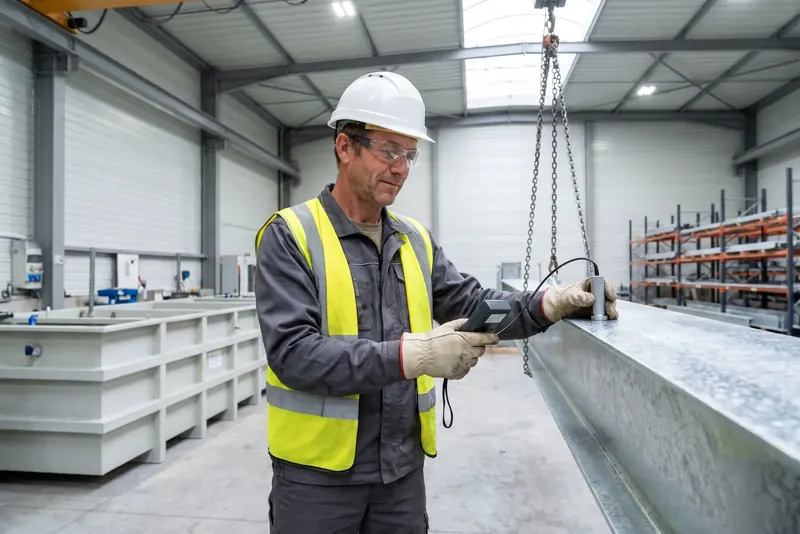
✓Request clarification regarding zinc thickness measurements and the inspection reports provided.
✓Ask to see examples of components processed for builders or steel fabricators.
✓Be cautious of any quote lacking initial mechanical preparation or clear chemical pickling stages.
✓A meticulous workshop will examine your fabrication drawings to confirm the presence of venting and drainage holes essential for hot immersion.
What makes the price of a galvanizer
The price depends primarily on the factors below. The exact price is the one stated or quoted by the pro for your specific requirements.
What affects the price
Total weight and volume of components to be treated
Type of treatment and specified coating thickness
Extent of initial surface preparation via blasting or pickling
Geometric complexity and presence of hollow sections
Get a call back from a galvanizer
For each service and each town, Kelki explains the essentials: the services, when to call a pro and pointers to choose well. With « Call me back », you describe your need in a few clicks: your request goes to a professional of the trade in your area, and you then deal with them directly.
Your requestFree
TradeGalvanizerLocationEverywhere in FranceServiceTo chooseTimeframeYou choose
A pro in your area calls you back · free
Your most common questions
How can I obtain a remote galvanising quote?+
Email your technical specifications together with dimensioned digital drawings. State the steel grade, estimated weight, overall dimensions, and your required treatment. The pro checks technical feasibility and issues a detailed written proposal. This document covers preparation stages, the chosen coating process, and shipping arrangements.
How is a remote surface treatment order handled?+
Once you validate the quote, you send the untreated items to the workshop by road freight. The team performs an intake inspection to spot any major defects and ensure vent holes are present. The items undergo the agreed treatment before being packed onto secure pallets. Return freight is then arranged back to your premises or installation site.
What documentation is provided after treatment?+
The supplier provides a detailed delivery note alongside an inspection report. This document attests to compliance with applicable standards and records the protective coating thickness measurements. For specific tenders, you can request a material sheet or tracking log. These records confirm traceability for all processing stages on your items.
How is my proprietary drawing data kept confidential?+
Industrial subcontractors follow strict protocols to protect all submitted client files. You can request a non‑disclosure agreement before sending your technical blueprints. Data access is strictly restricted to estimating and production departments. Suppliers undertake not to share your technical drawings without prior written consent.
Why must vent holes be drilled prior to hot‑dip galvanising?+
Hot‑dip galvanising requires hollow sections to be fully submerged in molten zinc. Without venting, trapped air builds up high pressure, risking catastrophic rupture of the fabrication. Drainage holes also allow liquid zinc to flow freely as parts exit the kettle. This avoids excessive thickness build‑up and surface defects.
What is the difference between hot‑dip galvanising and powder coating?+
Hot‑dip galvanising forms a zinc protective shield through a metallurgical bond with steel. Powder coating sprays a polymerised powder paint cured in an oven to add colour and an even finish. Both methods can be paired in a duplex system. This combined approach delivers maximum corrosion defence in harsh environments.
How are technical meetings with the workshop conducted?+
Discussions take place by phone or video conference with workshop technicians. You can share screens to review fabrication drawings and discuss suspension points. These regular check‑ins ensure treatment parameters are agreed without requiring you to travel to the subcontractor's premises.
What agreement formalises a surface treatment order?+
The commercial arrangement starts with an approved written quote followed by a purchase order. This document specifies part descriptions, quality standards, and freight conditions. It also defines the pricing schedule agreed between the parties. The workshop's general terms of sale complete the agreement.
Need a galvanizer?? Get a call back.
Free · No obligation · Describe your need in a few clicks
GalvanizerEverywhere in FranceSurface treatment request · Free · No obligationCall me back
K
Kelki AgentI connect you with pros in over 1,000 trades, in France.
Hello, I’m the Kelki Agent. Tell me what you need: I’ll find the right pro for you, close to home.
Messages are analysed by an AI to understand your need, and are not stored. Privacy
Cookies
We use cookies to improve your experience and analyse site traffic. About our cookies