Kelki searches.A real‑Time 3D developer calls you back.
Free · No obligation · A few clicks
Your need in one click
10 M+companies in our trades in FranceYour request goes to the real‑Time 3D developers in your area.
€0for your requestFree, no obligation, confirmed by you.
30 sto make your requestService, timeframe, town: a few clicks, and a professional calls you back.
Real‑Time 3D Developer nearby
A Real‑Time 3D Developer to build your professional immersive and interactive applications.
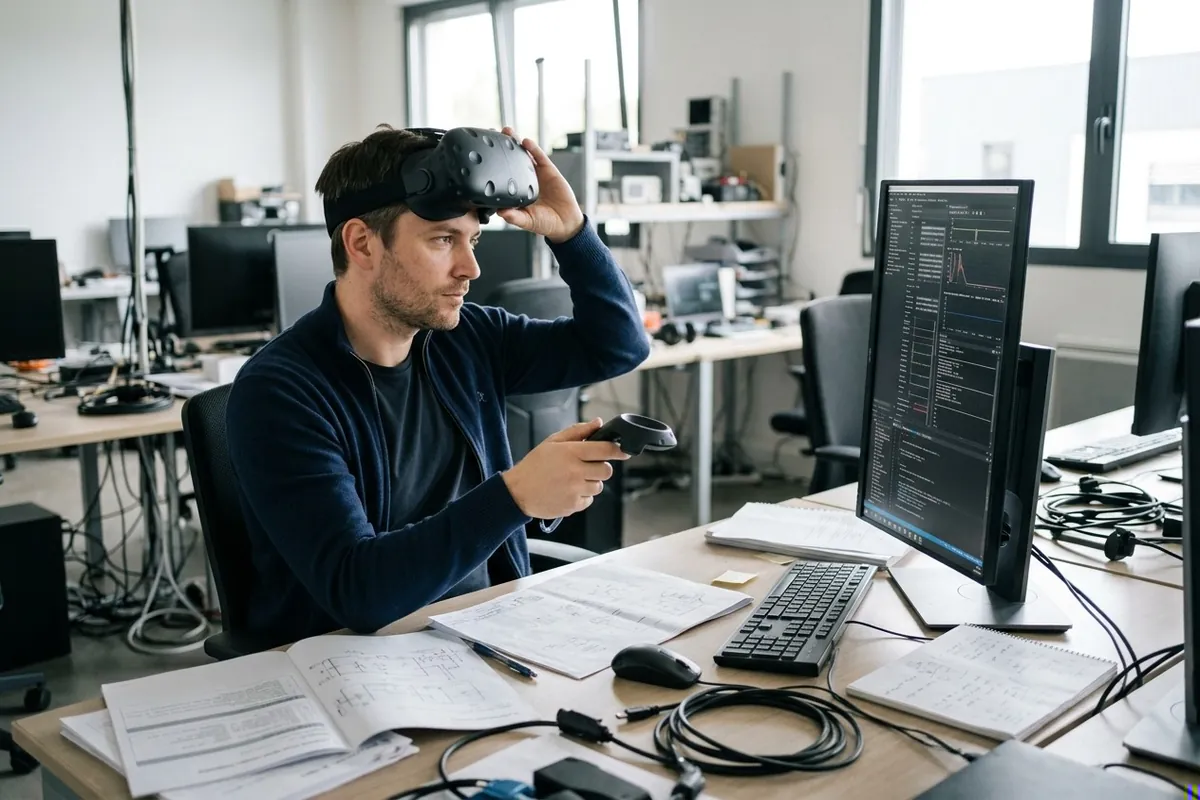
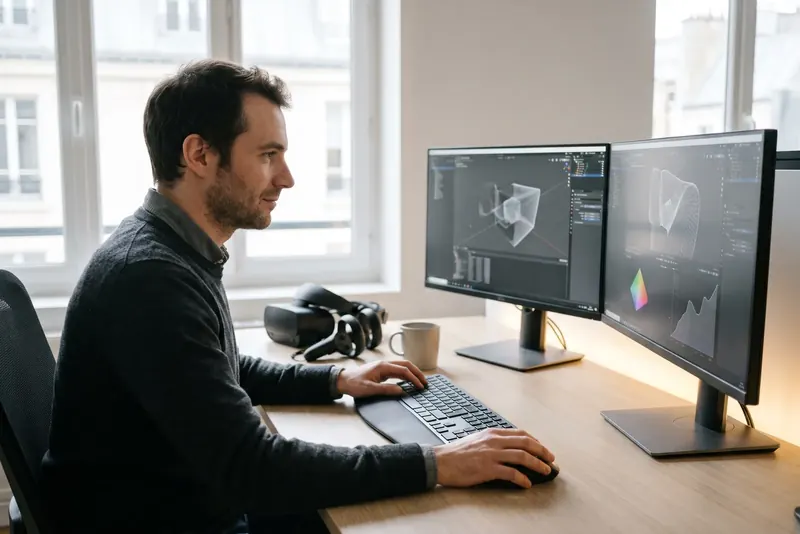
Looking for a Real‑Time 3D Developer or a webgl development agency in France? A real‑time 3D specialist programmes interactive virtual environments for industry, retail, and corporate training. They integrate 3D models, manage dynamic rendering, and code complex application logic. Their work runs smoothly on VR headsets, mobile devices, or standard web browsers, leveraging game engines, live image rendering, and robust software architecture.
Projects are predominantly delivered remotely across France. You share your specifications, design briefs, or raw visual assets digitally. Validation milestones are handled via video calls and live screen‑sharing sessions, with interim executable builds provided for your internal testing. In‑person meetings can also be arranged for final rollouts or tests on specialised on‑site hardware.
Your areaEverywhere in FranceYour request goes to the real‑Time 3D developers around you.
Your request · Real‑Time 3D Developer
Which service do you need?
Free · No obligation
Real‑time 3D development services
Common service
Custom VR application development
This service builds complete immersive software for virtual reality headsets tailored to your technical needs. Perfect for training simulators, industrial site walk‑throughs, or engineering design reviews. The developer configures realistic physical interactions, user navigation, and complete scenarios, delivering a fully tested executable binary for your target hardware.
Free · No obligation
Common service
Interactive WebGL development
This service runs real‑time 3D scenes directly in any modern browser without requiring extra plugins. Ideal for showcasing technical innovations, interactive product showcases, or complex data visualisations. The pro lightens polygon geometry, codes smooth animations, and optimises custom shaders to integrate seamlessly into your existing web stack.
Free · No obligation
Common service
3D product configurator
This service sets up a real‑time product customisation tool directly on your website. Widely used in e‑commerce, bespoke furniture, and industrial machinery. The developer connects modular assembly logic, dynamic texture swapping, and price variant calculations, linking the module directly to your digital catalogue or checkout system.
Free · No obligation
Common service
Mobile AR app development
This service builds mobile applications that overlay digital elements onto real‑world environments via camera feeds. It assists on‑site maintenance teams, enhances cultural exhibitions, or powers virtual product fittings. The specialist manages surface detection, spatial tracking, and visual stability, delivering an app ready for your device fleet.
Free · No obligation
Common service
Unity application development
This service harnesses the Unity engine to create cross‑platform interactive software. It suits demanding enterprise applications requiring high‑performance rendering on desktop or mobile platforms. The pro codes clean software architecture, integrates your visual assets, and delivers a well‑documented build alongside the agreed source code.
Free · No obligation
Common service
3D UI development
This service designs intuitive visual navigation and interactive spatial menus in three dimensions. Crucial for guiding users effectively inside virtual reality headsets or complex simulation tools. The developer implements spatial buttons, contextual floating panels, and haptic feedback to ensure comfortable, prolonged user sessions.
Free · No obligation
Common service
Web 3D deployment
This service handles the online setup and technical hosting configuration for your web‑based 3D assets. Carried out after core development, it covers asset compression, server caching, and cross‑browser performance checks. The pro verifies fast loading speeds across various screens, leaving you with an operational web link.
Free · No obligation
Common service
Standalone VR porting
This service adapts heavy PC‑based VR software so it runs reliably on standalone wireless headsets. Ideal for simplifying logistics at trade shows, pop‑up events, or mobile training sessions. The developer reduces polycounts and retunes graphical rendering pipeline settings to maintain stable frame rates on the headset's onboard mobile processor.
Free · No obligation
When to hire a Real‑Time 3D Developer
K
Is this your situation? A professional in your area calls you back to discuss it.Free · No obligation
When choosing a Real‑Time 3D Developer, review their completed projects on hardware and platforms similar to yours.
✓Ask to test an executable demo rather than relying solely on pre‑rendered videos or screenshots.
✓A clear written quote should outline the software architecture, delivery milestones, and intellectual property ownership of the source code.
✓Clarify how 3D assets are handled: whether your team supplies the raw CAD models or if the developer takes care of retopology and mesh optimisation.
✓Check their protocols for testing across your specific target devices.
✓Be cautious of vague answers regarding frame rates, target performance, or scene loading times.
✓Always establish a written agreement covering revision rounds and ongoing technical maintenance.
What makes the price of a Real‑Time 3D Developer
Pricing depends primarily on the factors listed below. The exact price is set out by the professional on their detailed quote, tailored to your technical requirements.
What affects the price
Complexity of custom interactive logic and physics programming
Volume and visual fidelity of 3D models to integrate
Target platforms, hardware devices, and operating systems
Level of web network and asset loading optimisation required
Get a call back from a Real‑Time 3D Developer
For each service and each town, Kelki explains the essentials: the services, when to call a pro and pointers to choose well. With « Call me back », you describe your need in a few clicks: your request goes to a professional of the trade in your area, and you then deal with them directly.
Your requestFree
TradeReal‑Time 3D DeveloperLocationEverywhere in FranceServiceTo chooseTimeframeYou choose
A pro in your area calls you back · free
Your most common questions
How does remote collaboration work on a real‑time 3D project?+
Work begins with a detailed review of your technical specifications during an initial video conference. You share reference materials and design assets via secure cloud transfer. The pro establishes a timeline with clear validation milestones. Each milestone includes a live video demonstration or an interim test build for your team to trial. Regular catch‑ups keep the project aligned until the final software package is delivered.
What details should I provide to get an accurate quote?+
Provide a comprehensive description of the user journey and required interactive features. Specify target devices, such as standalone headsets, mobile phones, or desktop web browsers. Clarify whether you are supplying ready‑to‑use 3D models or need the specialist to model them from scratch. Mention any specific network limits or operating systems to help calculate realistic development hours.
How can we protect technical data and confidential files?+
A non‑disclosure agreement (NDA) can be signed before you share sensitive engineering plans or technical designs. This agreement legally restricts data use and forbids external distribution. The service contract also outlines data storage and deletion protocols. Once development finishes, the formal transfer of economic and intellectual property rights over the custom code is documented in writing.
What deliverables are provided at the end of the project?+
The pro supplies the compiled application binary ready for your target hardware, or an optimised bundle ready for deployment on your web server. Depending on your contract terms, they also provide the fully documented source code and project scenes. Technical installation guides and user documentation are usually supplied alongside the files to support your internal IT team.
How do we test VR or AR builds without being in the same room?+
The developer compiles test builds and sends them across via secure download links. Your team installs the software on your local headsets or mobile devices to test functionality in real‑world conditions. Feedback is returned in writing or during live screen‑sharing sessions, where the headset video feed is cast onto a computer monitor so both sides can review behaviour in real time.
Who supplies the 3D models and textures for the application?+
You can provide your own CAD files, engineering blueprints, or 3D assets. The developer will clean, convert, and optimise these meshes for smooth real‑time rendering. If you have no existing visuals, the professional can model the required assets from scratch or integrate standardised technical libraries as defined in your initial project scope.
What is the difference between pre‑rendered visuals and real‑time 3D?+
Pre‑rendered graphics produce static images or fixed videos that cannot respond to user inputs dynamically. Real‑time 3D, by contrast, recalculates images dozens of times per second based on where the user looks and moves. This approach requires precise optimisation to maintain high, consistent frame rates, avoiding motion sickness in headsets and sluggish performance on web pages.
How is maintenance handled after the interactive app goes live?+
Initial quotes often include a warranty window for fixing unforeseen bugs post‑launch. For longer‑term needs, an ongoing maintenance agreement covers updates required by new operating systems, browser standards, or headset firmware. The developer adjusts the codebase over time to maintain hardware compatibility and resolve issues stemming from platform software updates.
Need a Real‑Time 3D Developer?? Get a call back.
Free · No obligation · Describe your need in a few clicks
Real-Time 3D DeveloperEverywhere in FranceReal-Time 3D Developer request · Free · No obligationCall me back
K
Kelki AgentI connect you with pros in over 1,000 trades, in France.
Hello, I’m the Kelki Agent. Tell me what you need: I’ll find the right pro for you, close to home.
Messages are analysed by an AI to understand your need, and are not stored. Privacy
Cookies
We use cookies to improve your experience and analyse site traffic. About our cookies